

Table of Contents
- The Truth About the 'Perfect' Daily Meal
- NHS Eatwell Guide Principles: Your Daily Meal Blueprint
- Building Your Healthiest Meal: The Core Components
- The 'One Meal' Fallacy: Why Variety Still Wins
- How to Meal Prep for a Balanced Diet Without Losing Your Mind
- Are Preservative-Free Hot Sauces Healthier? The Flavour Factor
- Your Daily Meal Formula: A Simple Framework
- Conclusion: Your Healthiest Meal Starts Tomorrow
- Frequently Asked Questions
Last Updated: September 5, 2026
The Truth About the 'Perfect' Daily Meal
The question "what is the healthiest meal I can eat every day?" is one of the most common in nutrition, yet it often receives misleading answers. The honest truth is that no single meal works universally, but there is a scientific framework for building one that supports your energy, digestion, and long-term health. The healthiest meal is not a specific recipe; it is a structure based on nutrient density, satiety, and balance that you can adapt daily.
At Spicy Rye's, we spend our time thinking about how flavour drives better food choices. A meal that tastes dull rarely gets repeated, while a vibrant plate encourages consistent healthy habits. This guide moves beyond generic lists to give you a practical, repeatable blueprint for constructing your own healthiest meal, using principles from the NHS Eatwell Guide as the foundation. We will show you exactly how to build a plate that satisfies you and fuels your body, without requiring you to eat the same bland chicken and broccoli every day.
NHS Eatwell Guide Principles: Your Daily Meal Blueprint
The NHS Eatwell Guide is the official UK benchmark for a balanced diet, and it provides the perfect starting point for your daily meal construction. It recommends that a healthy, balanced diet includes a variety of foods in specific proportions: plenty of fruit and vegetables, starchy carbohydrates, some dairy or alternatives, and proteins like beans, pulses, fish, eggs, and meat (the NHS). The guide also stresses limiting foods high in fat, salt, and sugar, which aligns with choosing whole foods over processed options.
This official guidance translates directly to your plate. To build the healthiest meal, you do not need to weigh every gram, but you should aim for rough proportions: fill half your plate with vegetables and fruit, a quarter with starchy carbohydrates, and a quarter with protein. This visual template, derived from official NHS healthy eating guidance, is easier to stick to than calorie counting and inherently promotes portion control.
Building Your Healthiest Meal: The Core Components
A truly healthy meal is a sum of its parts, each playing a specific role in keeping you full and energised. Rather than chasing a single "superfood," focus on combining the three core components below to maximise nutrient density and satiety. This is where the concept of the healthiest meal becomes practical.
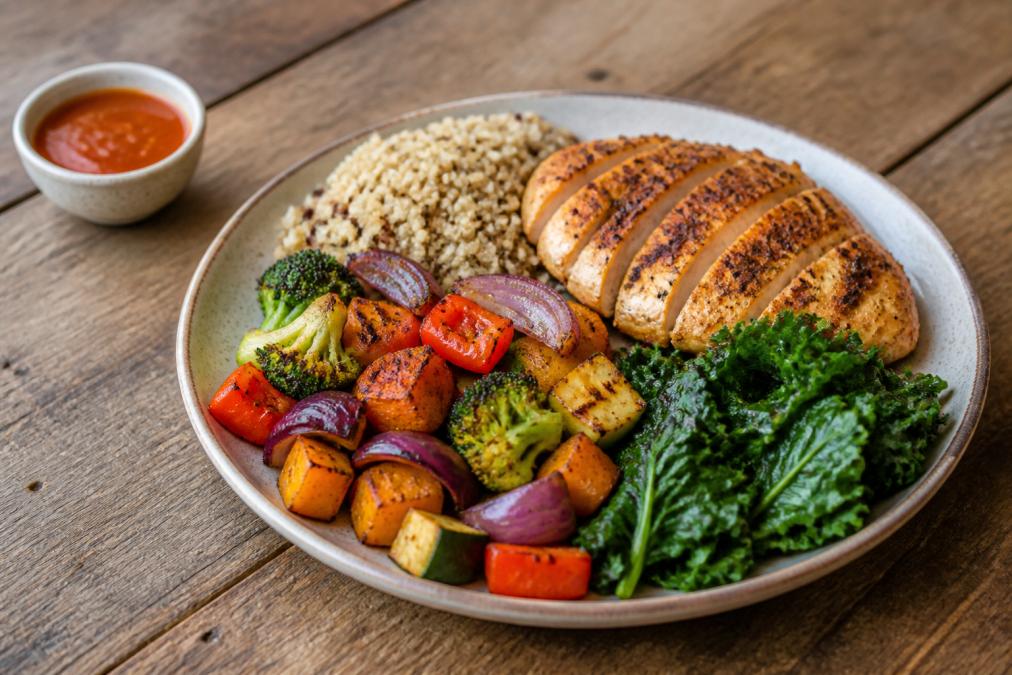
The Base: Starchy Carbohydrates and Fiber-Rich Choices
Your meal needs a solid base of starchy carbohydrates for sustained energy. The key is choosing whole grains and fibre-rich options over refined white versions, as they release energy slowly and keep you feeling fuller for longer. Think of options like quinoa, brown rice, wholemeal pasta, or a baked sweet potato with the skin on.
Swapping refined carbs for whole grains is one of the simplest upgrades you can make. These choices have a lower glycemic index, which helps maintain stable blood sugar levels and prevents the mid-afternoon energy crash. Adding a tablespoon of seeds or a sprinkle of beans to your base boosts the fibre content further, supporting good digestive health.
The Protein: Lean Protein and Plant-Based Options
Protein is the most satiating macronutrient, making it the cornerstone of any meal designed to keep you full. Lean protein sources like chicken breast, turkey, fish, and eggs are excellent, but you should also incorporate plant-based options such as lentils, chickpeas, and tofu for variety and additional fibre. Including a portion of oily fish like salmon a couple of times a week provides valuable omega-3 fatty acids for heart health.
The goal is to include a palm-sized portion of protein at every main meal. This not only supports muscle maintenance and metabolic health but also balances your blood sugar. If you are short on time, pre-cooked lentils or a can of beans are a fantastic, budget-friendly way to hit your protein target without fuss.
The Colour: Vegetables, Fruits, and Phytonutrients
The most visually vibrant part of your plate is arguably the most important for your micronutrient intake. Aim to fill half your plate with a rainbow of vegetables, including cruciferous vegetables like broccoli and kale, leafy greens like spinach, and colourful peppers. These provide essential vitamins, minerals, and phytonutrients that support everything from immune function to skin health.
Eating a variety of colours ensures you get a broad spectrum of antioxidants and electrolytes. A common mistake is sticking to the same two vegetables daily. Challenge yourself to rotate your choices, and do not forget that herbs and spices count too; they are packed with antioxidants and add flavour without added salt. This is also where a quality seasoning blend can transform a pile of plain veg into something you crave.
The 'One Meal' Fallacy: Why Variety Still Wins
Many people search for the healthiest meal because they want a single, simple answer they can repeat forever. This is what we call the "One Meal" fallacy, and it is a trap. Eating the exact same meal every single day can lead to nutrient gaps and flavour fatigue, which often derails healthy eating habits entirely.
Your body thrives on variety to obtain many micronutrients. Different vegetables provide different vitamins, and different proteins offer different amino acid profiles. Instead of finding one meal, your goal should be to master one framework and rotate the ingredients within it. This approach, known as bio-individuality, acknowledges that your body's needs differ from your neighbour's, and that your preferences will change seasonally. A healthy diet is a dietary pattern, not a single dish.
How to Meal Prep for a Balanced Diet Without Losing Your Mind
Meal prepping is the single most effective way to ensure you eat a balanced diet on busy days, but it does not have to mean eating the same sad container of food for four days straight. The secret is to prep components, not full meals. By cooking a batch of whole grains, roasting a large tray of mixed vegetables, and grilling a few portions of protein, you create a "build-your-own" buffet for the week.
This preparation efficiency allows you to assemble a fresh, balanced plate in under five minutes. Store your components separately in the fridge, and you can mix and match flavours to prevent boredom. For example, one day you might have your chicken with a soy and ginger dressing, and the next with a smoky paprika rub. This flexibility is key to long-term adherence to healthy eating. To make your vegetables irresistible, a pre-made, preservative-free seasoning blend is a game-changer for how to meal prep for a balanced diet effectively.
Are Preservative-Free Hot Sauces Healthier? The Flavour Factor
A recurring question is whether preservative-free hot sauces are healthier, and the answer is generally yes, because they avoid unnecessary additives. Many commercial sauces rely on preservatives to extend shelf life, but a cleaner label often means the flavour comes from real ingredients like chillies, vinegar, and spices. This aligns with the Eatwell Guide's advice to limit processed foods and excessive salt.
Beyond the health benefits, flavour is the secret weapon of a sustainable healthy diet. If your meals are bland, you are more likely to snack on processed foods later. Using bold condiments like hot sauce, chilli jam, or a punchy seasoning blend can make a plain piece of fish or a bowl of roasted vegetables genuinely exciting. At Spicy Rye's, we craft our products to be versatile pantry staples that help you stick to your healthy eating goals without sacrificing taste.
Your Daily Meal Formula: A Simple Framework
By now, the answer to the healthiest meal question should be clear: it is a framework, not a fixed recipe. To make this actionable, use the formula below every time you build a plate. This is your practical tool for constructing a nutrient-dense, satisfying meal that fits the UK dietary guidelines.
| Component | Proportion of Plate | Best Choices | Why It Matters |
|---|---|---|---|
| Vegetables & Fruit | 50% | Leafy greens, peppers, broccoli, berries | Provides micronutrients, antioxidants, and fibre |
| Starchy Carbohydrates | 25% | Quinoa, brown rice, sweet potato | Supplies sustained energy and fibre |
| Lean Protein | 25% | Chicken, fish, lentils, eggs | Builds muscle, promotes satiety |
| Flavour & Fats | To taste | Olive oil, avocado, Seasoning | Enhances absorption of vitamins and meal enjoyment |
Step 1: Start with your protein. Season it boldly with a blend like our Garlic & Herb Seasoning or Lemon Pepper Seasoning before cooking. Step 2: Cook a large batch of your chosen whole grain for the week. Step 3: Roast a tray of mixed vegetables tossed in a little oil and a sprinkle of Veggie Rockstar Seasoning to make them the highlight of the meal.


Conclusion: Your Healthiest Meal Starts Tomorrow
Finding the healthiest meal to eat every day is less about perfection and more about consistency. The perfect meal is one that is balanced, colourful, and enjoyable enough that you will want to eat it again tomorrow. By applying the Eatwell principles and building a plate that is half vegetables, a quarter whole grains, and a quarter lean protein, you are setting yourself up for success without restrictive dieting.
The biggest challenge is usually boredom, not willpower. This is where having a pantry full of versatile, high-quality flavour tools makes the difference between a diet that lasts and one that fades by Thursday. Spicy Rye's range of seasoning blends and sauces is designed to help you build healthy meals that taste anything but routine, turning simple ingredients into meals you genuinely look forward to. Get started with Spicy Rye's and make your healthiest meal the most flavourful one you eat all week.
Frequently Asked Questions
What is the no. 1 healthiest food in the world?
There isn't a single 'no. 1' food that covers all your needs. A healthiest meal relies on combining nutrient-dense foods: leafy greens, lean protein, whole grains, and healthy fats. Each provides different essential vitamins and minerals. Instead of chasing one superfood, focus on the synergy on your plate. A balanced meal following NHS Eatwell Guide principles will always outperform any single ingredient, no matter how hyped it is.
Can I eat the same healthiest meal every day?
Eating the exact same meal daily can lead to nutrient gaps and boredom, a trap known as the 'One Meal' Fallacy. While a meal like grilled chicken, quinoa, and broccoli is excellent, your body benefits from variety across dietary patterns. Rotate your proteins (fish, beans, eggs), switch your whole grains, and change your vegetable colours. This ensures you get a broader range of micronutrients and phytonutrients that no single meal can provide.
What is a healthy one-meal I can eat every day?
A practical template is a balanced plate: half filled with vegetables like leafy greens and cruciferous vegetables, a quarter with lean protein such as chicken or chickpeas, and a quarter with whole grains like brown rice. Add a source of healthy fats, like olive oil or avocado. Seasoning with flavourful, preservative-free hot sauces or seasonings helps you stick to this healthy pattern without it feeling like a chore.
Are preservative-free hot sauces a healthier addition to my daily meals?
Yes, they can be a smart swap. Preservative-free hot sauces typically rely on chillies, vinegar, and spices for flavour and natural preservation. They add bold taste with minimal calories and no artificial additives or added sugars. This helps make nutrient-dense foods like steamed vegetables or plain grilled fish more appealing. By choosing condiments without synthetic preservatives, you reduce your intake of processed food additives while keeping your meals exciting and sustainable.
This article was written using GrandRanker