

Table of Contents
- Why Gourmet Seasoning Blends Beat Supermarket Alternatives
- How to Choose High-Quality Seasoning Mixes
- Top Gourmet Seasoning Blends for Every Kitchen
- How to Use Gourmet Seasoning Blends in Everyday Cooking
- The Hottest Sauces UK: Seasoning Blends That Bring the Heat
- Storing Spices to Maintain Freshness and Shelf Life
- Conclusion
- Frequently Asked Questions
Last Updated: September 13, 2026
Why Gourmet Seasoning Blends Beat Supermarket Alternatives
Walk down any supermarket spice aisle and you will find rows of jars promising big flavour at low prices. Read the label closely, though, and the story changes: salt usually leads the ingredient list, followed by anti-caking agents, flavour enhancers and colours. That is not seasoning. That is filler with a familiar name.
Gourmet seasoning blends take the opposite approach. A gourmet seasoning blend is a small-batch mix of whole spices, herbs and aromatics, blended for flavour balance rather than shelf stability at any cost. At Spicy Rye's, we build our range around real ingredients like smoked paprika, cracked black pepper, lemon zest powder and scotch bonnet.
The practical difference shows up in your cooking. A blend built on quality spices needs less to do more, so you taste the seasoning rather than a mouthful of salt.
How to Choose High-Quality Seasoning Mixes
Judging a seasoning mix properly means scoring it against fixed criteria rather than trusting the front of the pouch. The four checks below are the ones most home cooks find separate a genuinely gourmet blend from a repackaged commodity spice.
1. Ingredient order and specificity. Ingredients are listed by weight, so the first three entries tell you what you are actually buying. A blend that opens with cumin, coriander and smoked paprika is built on spice. A blend that opens with salt, sugar or rusk is built on filler. Watch for catch-all terms such as "spices", "flavouring" or "herbs", these are legal but tell you nothing about quality or origin.
2. Cost per gram, not cost per pouch. Pouches vary wildly in fill weight, so the headline price is close to meaningless. Divide the price by the gram weight to get a true comparison. A 60 g pouch at £5.65 works out at roughly 9.4p per gram; a 100 g pouch at £6.50 works out at 6.5p per gram, nearly a third cheaper per gram despite the higher sticker price (gov.uk). A blend that costs more per gram but needs half as much per dish can still be the better value, so weigh cost-per-gram against the recommended dose on the pack.
3. Salt and sugar position. Salt is cheap; spice is not. If salt appears in the first two ingredients, you are paying gourmet prices for something you already have in the cupboard. The same logic applies to sugar, dextrose and maltodextrin, which are common bulking agents in barbecue and jerk-style blends. A useful rule of thumb: the further down the salt sits, the more of your money is going into actual spice.
4. Aroma, colour and grind. Open the pouch and smell it. A fresh blend should hit you immediately, if you have to put your nose in the bag to detect anything, the volatile oils have already gone. Colour should be deep and uneven rather than uniformly dusty; visible flecks of herb, chilli and cracked seed indicate batch blending rather than industrial milling to a powder.
5. Dietary fit. This is where most review articles stop short. If you are managing sodium intake, look for blends where salt is absent or listed last, and season at the pan rather than in the pouch. For gluten-free cooking, check for wheat-derived anti-caking agents, rusk or malt vinegar powder. For nightshade sensitivity, scan for paprika, cayenne, chilli and tomato powder, which rule out most jerk, harissa and barbecue blends. Coeliac cooks should look for a gluten-free claim backed by the ingredient list, not just a "no gluten ingredients" statement on the front (coeliac.org.uk).
6. Preservative and additive load. Anti-caking agents such as silicon dioxide, flavour enhancers such as monosodium glutamate, and added colours are all legal and all common. Their presence is not automatically a problem, but a blend that relies on them is usually compensating for weaker base spices. Cross-check any "preservative-free" or "all-natural" claim against the full ingredient panel rather than the marketing copy.
The Food Standards Agency guidance on food labelling sets out what a label must legally declare, including allergen information, which is the fastest way to verify a gluten or nightshade claim before you buy.
Top Gourmet Seasoning Blends for Every Kitchen
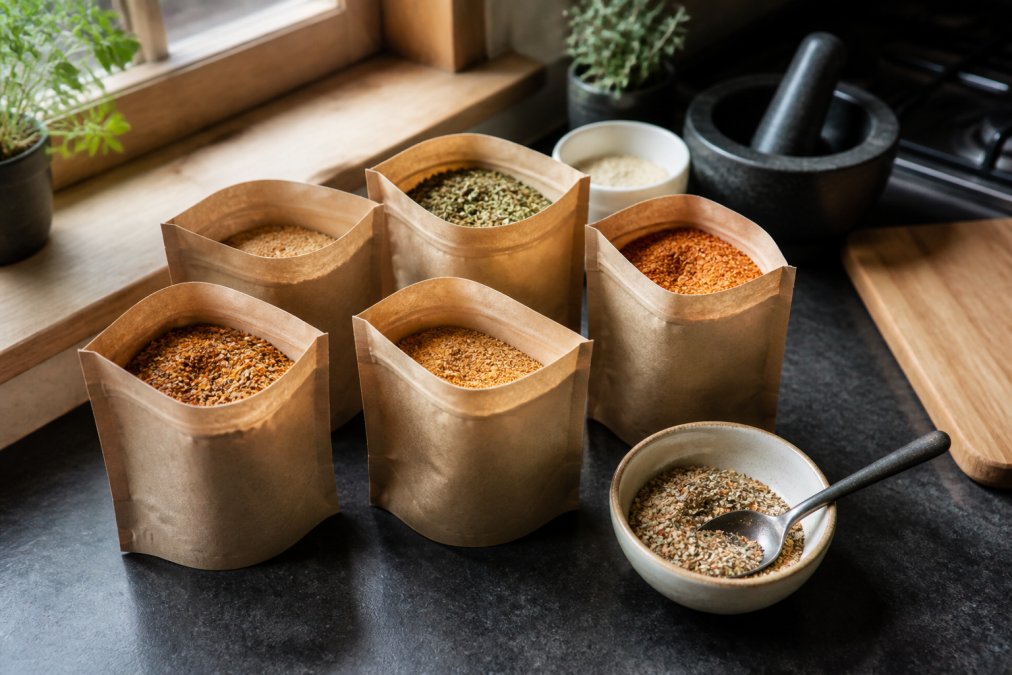
The best gourmet seasoning blends for home cooks are the ones you reach for weekly, not the ones saved for a special occasion. A well-stocked shelf covers four jobs: heat, smoke, citrus and herb. Here is how our range maps onto those needs.
| Blend | Flavour Profile | Best For | Heat Level | Price |
|---|---|---|---|---|
| Jamaican Jerk Seasoning | Smoky, sweet, allspice warmth | Chicken, pork, tofu, veg | High | £5.65 |
| Peri Peri Seasoning | Zesty lemon, smoky paprika, garlic | Chicken, prawns, chips | High | £5.65 |
| Moroccan Harissa Seasoning | Earthy, smoky, caraway and cumin | Lamb, chickpeas, roast veg | Medium | £5.56 |
| Smoky Barbecue Seasoning | Sweet molasses, coffee, chipotle | Ribs, brisket, jackfruit | Medium | £5.65 |
| Lemon Pepper Seasoning | Bright citrus, cracked pepper | Fish, chicken, potato wedges | Low | £5.65 |
| Garlic & Herb Seasoning | Punchy garlic, herbs, citrus zing | Pasta, veg, chicken | Low | £5.56 |
| Secret Chicken Seasoning | Smoky paprika, lemon zest, herbs | Wings, roast chicken, chips | Low | £5.56 |
| Signature Lamb Seasoning | Mint, rosemary, lemon, sumac | Lamb chops, koftas, racks | Low | £5.56 |
| Legendary Beef Seasoning | Pepper-forward, rosemary, garlic | Steaks, burgers, brisket | Low | £5.56 |
| Thai Sriracha Seasoning | Garlic, sweet chilli, vinegar tang | Wings, noodles, popcorn | Medium | £5.65 |
If you want one blend that covers the widest ground, Garlic & Herb Seasoning handles chicken, vegetables and pasta without clashing with anything else in the dish. For pure heat with complexity, Jamaican Jerk Seasoning is the standout, with scotch bonnet, allspice and thyme doing the heavy lifting.

How to Use Gourmet Seasoning Blends in Everyday Cooking
Using gourmet seasoning blends well comes down to timing and application, not quantity. Treat them as a finishing layer as well as a cooking ingredient, and you will get more from every pouch.
A simple weeknight framework:
- Dry rub: pat protein dry, oil lightly, coat generously, rest 30 minutes.
- Marinade: mix 2 tbsp blend with lemon juice, oil and a splash of vinegar.
- Finishing dust: sprinkle lightly over chips, popcorn or roast veg straight from the oven.
- Infused oil: stir a teaspoon into warm oil and brush over meat while cooking.
For anyone new to cooking with blends, start with a lower heat level and build up. Peri Peri Seasoning works as a marinade for chicken or prawns, while Lemon Pepper Seasoning suits fish and roast vegetables where you want brightness rather than fire.

The Hottest Sauces UK: Seasoning Blends That Bring the Heat
Heat in a dry blend behaves differently from heat in a sauce. Without liquid to dilute it, chilli-forward rubs hit faster and fade quicker, which is why blends built on scotch bonnet, cayenne and chipotle are the backbone of the hottest sauces in UK kitchens right now.
For genuine heat, three blends lead our range. Jamaican Jerk Seasoning brings scotch bonnet with allspice and thyme for depth. Peri Peri Seasoning pairs cayenne and chilli flakes with lemon and garlic for a sharper burn. Thai Sriracha Seasoning delivers garlic, sweet chilli and a vinegar tang that mimics the sauce in dry form.
Storing Spices to Maintain Freshness and Shelf Life
Most storage advice stops at "keep them cool, dark and dry". That is correct but incomplete, because it does not tell you how to know when a blend has actually died. Spices do not spoil in the food-safety sense, they fade. The volatile oils that carry aroma oxidise and evaporate over time, and ground spices lose potency far faster than whole ones because the surface area exposed to air is vastly greater.
A practical shelf-life test. You do not need equipment. Rub a small pinch between your fingers and smell it. A live blend releases a sharp, layered aroma immediately, you should be able to pick out at least two distinct notes. A dead blend smells dusty, flat or faintly of hay. If you have to concentrate to detect anything, the blend has lost the oils that made it worth buying. A second test: bloom a teaspoon in a little warm oil. A fresh blend will perfume the oil within seconds; a spent one will barely register.
What actually degrades a blend.
- Heat accelerates oxidation. A pouch stored beside the hob cycles through temperature swings every time you cook.
- Light breaks down pigments and aromatic compounds, which is why clear jars on an open shelf fade fastest.
- Air is the main culprit. Every time you open a pouch, oxygen enters and volatile oils escape. Resealing with the air pressed out matters more than most people realise.
- Moisture clumps blends and can introduce mould in extreme cases. This is why the fridge is usually the wrong choice, condensation forms each time the container is removed.
- Cross-contamination from a wet spoon is a common and avoidable cause of clumping and off-flavours.
Storage method comparison.
| Storage Method | Aroma Retention | Best Practice |
|---|---|---|
| Open pouch on shelf | Poor | Avoid; reseal immediately after each use |
| Airtight jar, dark cupboard | Good | Ideal for daily-use blends; keep away from the hob |
| Fridge storage | Poor | Skip; condensation degrades spices |
| Freezer, sealed and airtight | Good | Only for long-term backups; allow to reach room temperature before opening |
Habits that extend shelf life.
- Press excess air out of the pouch before sealing, or decant into a small airtight jar that leaves little headspace.
- Label and date anything you decant, so you are not guessing six months later.
- Use a dry spoon, never a wet one, and never shake a blend directly over a steaming pan.
- Buy in quantities you will finish within a few months rather than bulk-buying blends you use twice a year.
- Keep a small working jar and store the bulk pouch sealed and dark, refilling the jar as needed.
Conclusion
Building a kitchen that tastes better than the supermarket version comes down to choosing blends built on real spices, not salt and filler. Start with one heat-forward blend and one herb-forward blend, store them properly, and you will use both far more often than you expect. Browse the full Spicy Rye's range of preservative-free seasoning blends and rubs, made with premium ingredients and priced from £5.56, and find the flavour that fits your weeknight cooking. Elevating your pantry beyond savory applications often leads to questions about whether premium baking mixes provide a similar shortcut to quality results in the dessert course.
Frequently Asked Questions
What should I look for when buying premium seasoning blends?
Check the ingredient list first. Quality blends use whole spices that are toasted and ground. Look for a clear ratio of salt to spices; salt should not be the first ingredient unless it's a salt-based rub. Also consider the flavour profile and heat level to match your cooking style. Spicy Rye's blends, for example, list all ingredients transparently.
How do gourmet spice blends differ from supermarket alternatives?
Supermarket blends often bulk up with salt, sugar, and fillers, and they may sit on shelves for months, losing potency. Gourmet blends typically use higher-quality, freshly ground spices and are made in smaller batches. That means more flavour per gram, so you use less. The difference is noticeable in dishes where spices play a leading role.
Are artisanal spice blends worth the extra cost?
If you cook from scratch regularly, yes. A £5.56 pouch of a blend like Spicy Rye's Moroccan Harissa Seasoning can season multiple meals, and because the spices are more potent, you need less per dish. Compared to buying individual spices to recreate the same flavour, artisanal blends often work out cheaper per serving and save time. They also last longer if stored properly.
How can I store gourmet seasoning blends to keep them fresh?
Keep them in airtight containers away from light, heat, and moisture. A cool, dark cupboard is ideal. Avoid storing them above the hob or near the kettle. Whole spices last longer than ground. If a blend smells weak or looks faded, it's time to replace it. Spicy Rye's pouches are resealable, which helps maintain freshness.
Can I use gourmet seasoning blends on everyday meals?
Absolutely. Blends like Garlic & Herb or Lemon Pepper are designed for daily cooking. Sprinkle them on roasted vegetables, chicken, fish, or chips. You can also mix them with oil or yoghurt for a quick marinade. The key is to start with a small amount and adjust. Unlike single spices, blends are balanced, so they rarely overpower a dish.